The products
The original K-Tor product was the Pocket Socket — a hand-crank generator small enough to fit in a pack, capable of charging a phone or running a small device anywhere you happen to be. No sun required. No batteries to die. Just your hand and a crank.
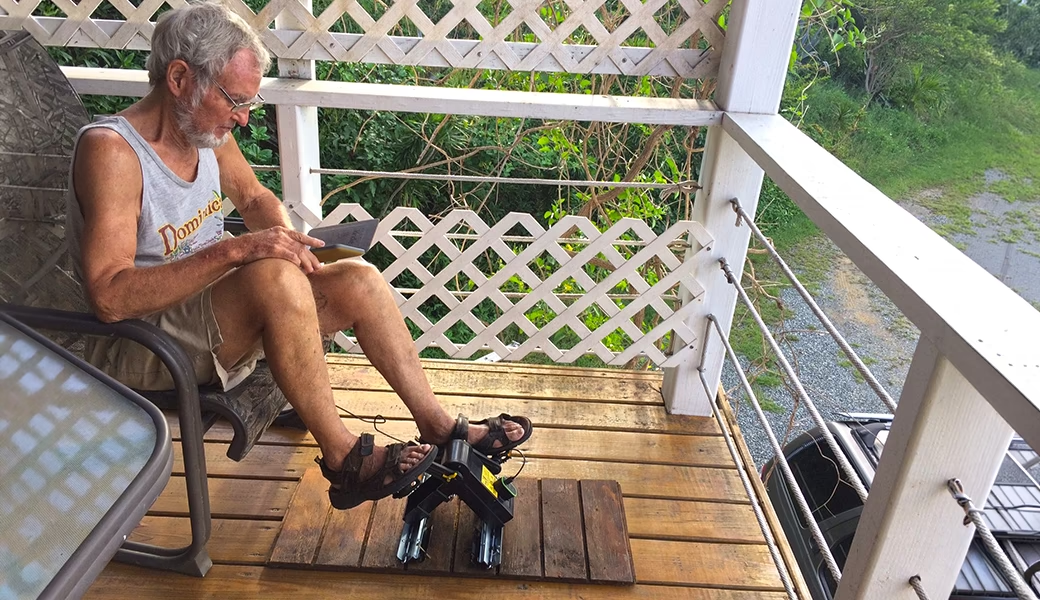
The second product was the Power Box — a foot-pedal generator on the same principle, driven by legs instead of arms and producing more power as a result. Sit down, pedal, charge your laptop. The physics are simple and the execution is clean.
The third is an Emergency Disaster Kit combining both approaches for preparedness situations where grid power is gone and may stay gone. The audience is emergency preparedness households, campers, hikers, preppers, and anyone who has thought seriously about what happens when the power goes out and doesn’t come back quickly.
The products are genuinely better than solar-powered generators in one important respect: they don’t need sun. A cloudy week after a hurricane is exactly when you need power and exactly when solar fails you. A K-Tor generator works in a basement in the dark. That’s not a small thing.
The client
Ken Torino spent his career at IBM as an Executive and electrical engineer. He’s the kind of person who solves problems methodically and builds things that work. K-Tor was supposed to be what came after IBM — a small product company he could run on his own terms, generating enough revenue to make retirement comfortable.
The products sell steadily. The reviews are good. The concept is sound. But volume has never reached the level that would let Ken step back. He’s had to return to work, running K-Tor on the side rather than as the main event. The retirement project is still running — it just hasn’t retired its owner.
There’s an honest irony in that for a product built around human-generated power: the company, too, runs entirely on one person’s energy.
The products are better than solar in the situations that matter most. The problem isn’t the technology. I suspect people just don’t want to work at power generation.
— A note on the marketing challenge
The site
We’ve been building and maintaining k-tor.com since 2011. The platform is WordPress with WooCommerce — straightforward eCommerce for a small catalog of physical products. Three products, a shop, product pages, a support section, and enough content to explain what human-powered generation actually means to someone who’s never thought about it.
The site has been rebuilt a few times over the years, most recently in 2018. It runs on older technology at this point — Thesis, WooCommerce, the Flex skin — and is overdue for a modernization pass. That’s a conversation Ken and I keep having. Small product companies on tight margins don’t always move fast on rebuilds, and a site that works well enough has a way of staying exactly as it is.
What hasn’t changed is that the site does its job. Orders come in. Products ship. Customers who need what K-Tor makes find it and buy it. For a niche product with a specific audience, that’s the whole assignment.
The market
Human-powered generators occupy an interesting position in the preparedness market. Solar has captured most of the mindshare — portable solar panels are everywhere, heavily marketed, and feel high-tech. Human power feels like work, because it is work. That friction is real and it affects buying decisions.
What the marketing has to do — and what the site tries to do — is reframe the work as a feature rather than a bug. When the grid is down after a major storm and the sky has been overcast for four days, a hand crank is not a compromise. It’s the only thing that works. The preparedness audience understands this. The broader market is harder to reach.
Ken has the right product for a world where grid reliability is increasingly in question. Whether the market catches up to that reality before he’s ready to actually retire is an open question.
K-Tor is still running, still selling, and still on my client list after fourteen years. The retirement project hasn’t retired yet. Neither has the site.
Want to see more of the work? →